 English


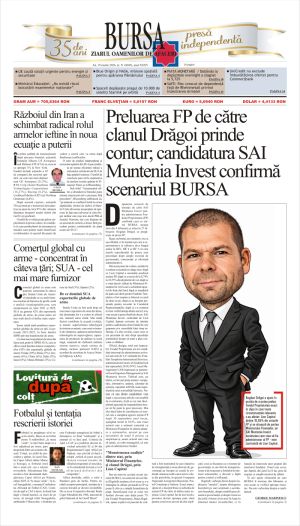
The submission of the letter of intent by SAI Muntenia Invest for the management of Fondul Proprietatea (FP) confirms what the BURSA newspaper announced on February 4 and resumed on February 27: Bogdan Drăgoi is preparing to take over the respective fund.
Certainly, not brutally, not ostentatiously, not with the door slammed, but in the manner he has experimented and refined over the years at SIF1, SIF 4 and SIF 5, in which the great power repositionings are presented as simple exercises in governance, competition and administrative efficiency.

From this point of view, we are witnessing an action executed in cold blood: after Lion Capital has rapidly accumulated FP shares, after it has gone from 8.74% to 10.55% of the voting rights, after it voted decisively alongside the Ministry of Finance at the AGM that changed the balance of power in the fund, after the four-year mandate desired for Franklin Templeton was rejected and replaced with one of only one year, after the pressures for revocations in the Board of Representatives began, after the alliance between the state and Lion has become increasingly visible, now comes the final piece of decor: SAI Muntenia Invest, controlled by Lion Capital, submits a letter of intent to manage the very fund in which the group has consolidated its influence in the meantime. In other words, what was presented by some as journalistic speculation is starting to look like a patiently executed plan.
Officially, of course, everything is impeccable. Fondul Proprietatea has three candidates interested in managing its 2.31 billion lei net assets: Franklin Templeton International Services, the fund's historical administrator since September 2010, INVL Asset Management UAB together with local partner Impetum Management and SAI Muntenia Invest. The picture is, on paper, that of a mature market: competition, alternatives, options, selection calendar, reporting to BVB, all the ingredients of stock market normality. However, one of the candidacies comes after such a convenient sequence of events that even the most disciplined appearance of impartiality is beginning to be put to the test. Especially if we consider that the actor who aggressively bought FP shares after September 30 last year, recently reaching 10.5%, is exactly the actor who acted in concert with the Ministry of Finance in the last shareholders' meeting, the actor that retail investors view with suspicion and, now, the actor who comes to say, with managerial calm, that he is ready to manage the fund.
• The "monstrous coalition" between the state, through the Ministry of Finance, and the Dragoi clan, through Lion Capital
In a recent interview with the BURSA newspaper, Slovenian investor Matej Rigelnik claimed that everything that has happened recently at FP cannot be read as a simple market formality. The real beneficiary of the three Slovenian funds that hold over 7% of Fondul Proprietatea, Matej Rigelnik, explicitly says that the turning point was the moment when the transparency initiative and the new governance direction began to highlight the real value of some key assets in the portfolio, especially the National Airports Company of Bucharest, the Port of Constanta and Salrom. Exactly then, he says, the acquisition of FP shares by the second largest shareholder, Lion Capital, suddenly began. And from here on, the story becomes almost too clear to need any further explanation: what had started as a governance reset, as an effort to make the fund more transparent and reposition it in the interests of shareholders, became a struggle for control and influence.
Rigelnik speaks directly about the involvement of the "state", about the destruction of the trust that shareholders had given to the board, about the change in the dynamics of governance and about the risk that future decisions will no longer be taken in the interest of all investors, but according to the interests of some groups within the fund. The tone is severe, but the facts around it make it difficult to dismiss it as simple camp rhetoric.

And here appears the element that BURSA had noticed since February and which is now being verified almost mechanically. It is not just about a candidacy. It is about a succession of moves in which the acquisition of packages, the alignment with the state in decisive votes, the repositioning of the board, the limitation of Franklin Templeton's mandate, the challenge and pressure on some members of the Board of Representatives and, finally, the appearance of its own management vehicle in the race can no longer be treated separately. In any other circumstance, such a sequence would have been called a strategy.
The alliance between the Ministry of Finance and Lion Capital is, in this context, the keystone of the entire mechanism. After the AGM of February 26, the balance of power changed precisely because the Romanian state aligned its vote with Lion Capital. Rigelnik even insists on correcting the wording and says that, due to a dispute over the name, for him Lion Capital still remains SIF1, which adds an almost nostalgic note to the whole situation: the old reflexes of local capitalism are proving, here, more resistant than rebranding.
He evokes, not by chance, the "monstrous coalition”, the historical episode in which antagonistic forces united to defend their interests against a reform project. The comparison may seem theatrical, but it is supported by details that are hard to ignore. The government issued a special power of attorney so that the state could vote for a secretary of the AGM proposed by SIF1, and the Minister of Finance, Alexandru Nazare, signed two powers of attorney: one for voting and one special one for appointing the secretary to count the votes. In addition, Rigelnik claims, no one else was allowed to participate in counting the votes. The resulting image is that of such a disciplined alignment between the state and the private shareholder that the idea of a simple coincidence begins to take on an involuntary humorous tone.
• Lion Capital consolidates its position in FP
In parallel, movements within the board of Fondul Proprietatea have completed the picture. Lion Capital requested the addition of the agenda of the AGM of March 30, 2026 with the dismissal of Matej Rigelnik from the position of member of the Board of Representatives, arguing that the proposal to grant a new four-year mandate to Franklin Templeton did not comply with the shareholders' request of September 2025 regarding the start of a new administrator selection process.
This is exactly the same type of argument used by the Ministry of Finance for the dismissal of Istvan Sarkany and Florian Munteanu, which shows once again how spontaneously the public institution and the private shareholder can think in unison when the common interest requires it.
On the other hand, the Slovenian funds Equinox, Axor Holding and Intus Invest, together with Rigelnik, requested the dismissal of Andrei Octav Moise, arguing that he was elected to the board by the vote of minority shareholders, but sold his stake and is therefore no longer a FP shareholder. The detail becomes even more interesting by the fact that Moise, together with close people, sold 3.3% of the fund to Lion Capital and that, according to the opinions expressed in the AGM, he voted in favor of the proposals of the Ministry of Finance and Lion Capital, contributing to the tipping of the balance in the shareholders' meeting. Subsequently, on March 3, Moise bought 101 FP shares, a move modest enough to produce a bitter smile rather than a fundamental reset of perception.
All this time, Lion Capital did not limit itself to political or board actions, but methodically continued its consolidation in the shareholding. At the end of the meeting on March 10, it controlled 337.6 million voting rights, or about 10.55% of the total.

On the same day, four deals were made on the market with 27.1 million FP shares, equivalent to 0.85% of the capital, at the price of 0.6 lei per share, 4.71% above the reference in the regular market. At the beginning of the month, the holding was 8.74%. Therefore, in a few days, the increase was substantial, and the context in which it occurs says a lot: exactly during the period in which internal control is being redesigned and the fight for the administrator is being prepared.
• SAI Muntenia Invest candidacy, a pro-Lion Capital candidacy
Against this background, SAI Muntenia Invest's candidacy gains the weight of an act of confirmation, not of debut. SAI Muntenia Invest is not a name that appeared out of nowhere, but was launched by the administrator of Longshield Investment Group, the former SIF Muntenia, and is owned by Lion Capital. In other words, Bogdan Drăgoi's group is not content with influencing Fondul Proprietatea from the position of a large shareholder and a temporary ally of the state, but is now explicitly in the race for direct management of the fund. It is no longer an influence from the sidelines, it is no longer just a construction of majorities in the AGM, but an actual candidacy for the keys to the vault. Or, more elegantly put, for the mandate to manage one of the most important vehicles of the Romanian capital market.
The contrast with the other competitors is instructive. Franklin Templeton has been managing Fondul Proprietatea since 2010 and has just received a new mandate of just one year, until April 2027, after the proposal for four years was rejected by the votes of the Ministry of Finance and Lion Capital. INVL Asset Management, an alternative asset manager from the Baltic countries, comes together with Impetum Management, part of Impetum Group. In September last year, Fondul Proprietatea shareholders canceled the selection process that began at the end of 2023, at the end of which the Board of Representatives had selected the partnership between IRE AIFM HUB from Luxembourg and Impetum Mana gement as the preferred candidate for the management of the fund. So, this track is not a new one either. However, in the meantime, the game has moved from the formal area of selection to the much tougher area of shareholder power and governance control, and here the advantages are no longer distributed equally.
• Will FP become SIF 6?
The problem is not a sentimental one, but a structural one. Fondul Proprietatea was created to compensate Romanian citizens for properties confiscated by the state during communism and has become, over time, one of the most successful stories of the Romanian capital market, a symbol of transparency, discipline and respect for shareholders. That is precisely why the question circulating in the market, whether Fondul Proprietatea will become a "SIF 6”, is devastating by its simple formulation. Not because it is just a polemical label, but because it expresses the fear that the fund could slip away from the modern corporate governance model towards a system in which influence is worth more than rules, and temporary alliances more than the interest of all shareholders.
In light of all this information, the submission of the letter of intent by SAI Muntenia Invest is not an isolated piece of news, and the articles published by BURSA on February 4 and 27 were confirmed by the facts that occurred subsequently. First, the Dragoi clan built its position in the shareholder base. Then it achieved alignment with the state, after which it shortened the long mandate of the historical administrator. The purge and pressure movements in the board followed, and finally, the icing on the cake: the submission of its own letter of intent for the administration of FP.
It is hard to say what else would be missing to make the scenario more explicit, perhaps just an official statement that this entire sequence of events is purely coincidental and that Bogdan Drăgoi arrived in a position to take over Fondul Proprietatea at the exact moment when all the relevant circumstances aligned, happily, again.
According to the procedure, a selection process will follow. The Remuneration and Nomination Committee will inform the market about the calendar of subsequent stages, and the procedure continues. Also formally, Lion Capital even gave up on a previous proposal to complete the agenda so that the FP board could start a process of selecting the administrator, which could be interpreted as a sign of flexibility or, depending on taste, as a tactical adjustment. But this is precisely where the underlying irony of the whole situation lies: the better the procedural appearances are respected, the more sophisticated the power outcome becomes. The door is not forced, the access code is discreetly changed. The administration is not formally confiscated, the conditions are created for the administration to "naturally” end up exactly where it was supposed to end up.
Therefore, the real stake is no longer whether SAI Muntenia Invest has the right to run; obviously it does. Nor whether Lion Capital has the right to buy shares; obviously it does. Nor whether the Ministry of Finance has the right to vote as it sees fit; obviously it does. The stake is different and much more serious for the capital market: whether Fondul Proprietatea, built as a symbol of citizens' compensation and modern governance, is pushed through conjunctural alliances and strategic accumulations towards the area of influence of a group that has prepared its ground step by step, despite the alarm signals raised by the market and minority shareholders. And at this point, the submission of the letter of intent by SAI Muntenia Invest can no longer be read as simple stock market flow information.

















 Euro
Euro Dolar SUA
 Franc elveţian
 Liră sterlină
 Gram de aur























Reader's Opinion